
"Whose Lap Is It Anyway? Decoding the Mystery of Munich Glyptothek 122"
Monday, August 17, 2026. 7 pm Hybrid
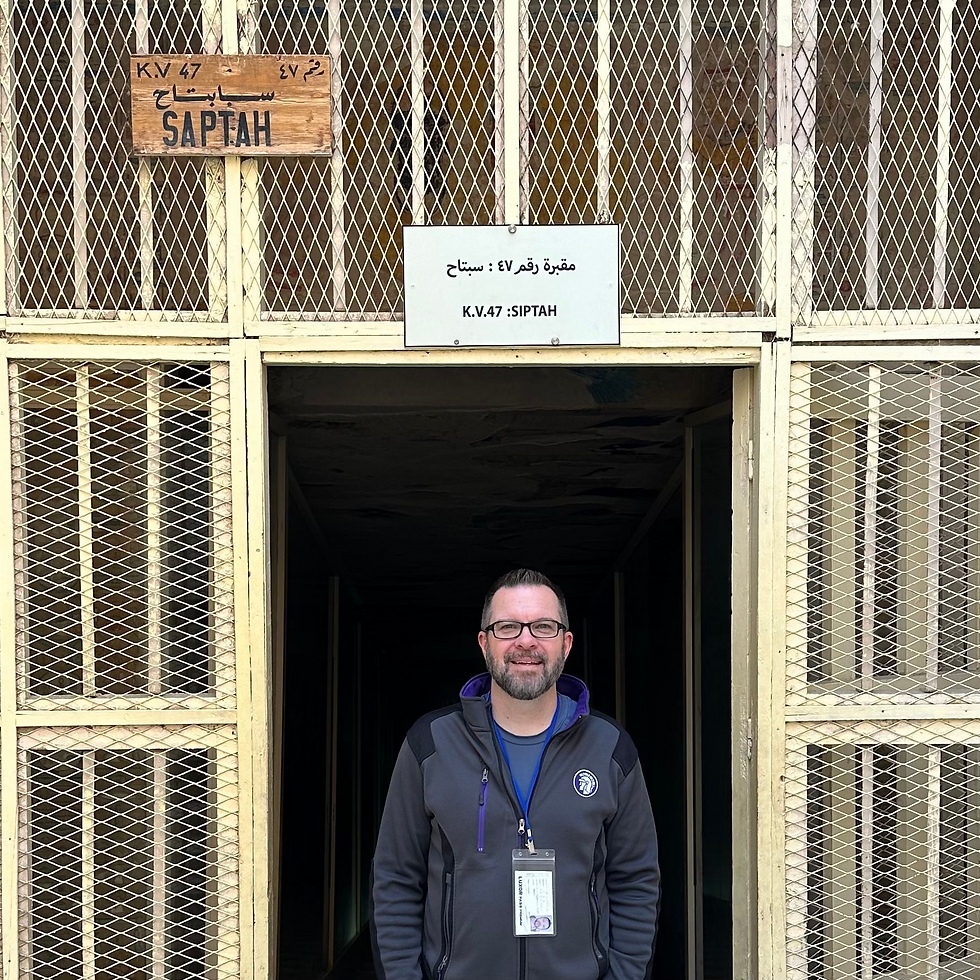

Speaker: Dr. Kevin Johnson. Kevin Johnson is Chair of the Department of History, Global, and Political Studies and Associate Professor of History and Global Studies at Taylor University in Upland, Indiana. His research focuses on the late Nineteenth and early Twentieth Dynasties, a pivotal period in Egyptian history.
Our meetings are free and open to the public. Members will receive the Zoom link by email. If you are not a member and would like to attend this talk, please contact us to receive the Zoom link.
Location: Englewood Public Library, Hampden Room, 1000 Englewood Parkway, Englewood, CO 80110. The Hampden Room is located on the second floor of the Englewood Civic Center Building (Google Map Link). The Civic Center Building can be reached via S. Broadway, W. Hampden Ave and S. Santa Fe Drive. There is free parking accessible from S. Inca Street (enter the building on the 1st floor) and S. Jason Street (enter the building on the 2nd floor and take stairs/elevator to 1st floor). Public transit is also available at the nearby Englewood Light Rail Station and Bus Transfer Loop (Parking and Public Transit Link). For public transit information, please visit RTD's Trip Planner Web Page.
ABSTRACT: The transitional period between the Nineteenth and Twentieth Dynasties is an epoch in Egyptian history about which little is understood, as scant archaeological evidence from this period survives to the present, certainly when compared to the embarrass de richesses from the first half of the previous dynasty. It is, however, one of the more fascinating chapters of Egypt’s past, featuring Siptah, a young king with a physical disability of uncertain royal background; Bay, a non-royal official and possible foreigner, who wields unprecedented power and seems to have paid the consequences for overreaching; and Tausret, a king’s wife, Queen regent, and ultimately a female pharaoh, one of the rare women to rise to Egypt’s throne. Upon her death, Sethnakht, a man of unknown genealogical and occupational background, ushers in a new dynasty. Given the limited amount of material we have for this period, each surviving piece of the historical puzzle has increased importance as we attempt to gain insight into this pivotal period. How one interprets the surviving material evidence, therefore, can have a profound impact on the reconstruction of events from this period. This presentation investigates one of those fascinating pieces of evidence from the turbulent end of ancient Egypt’s 19th Dynasty, a desecrated group statue known as Munich Glyptothek No. 122. This unique monument originally depicted the child-king Siptah seated upon the lap of a powerful guardian, yet his larger figure was later meticulously and intentionally erased in a targeted act of political damnatio memoriae. By decoding the symbolism of the "lap-sitting" motif —traditionally used in Egyptian art to express intimate protection, nurturing, and regency —and comparing it to other artistic examples from this period, we will engage with various theories as to the potential identities of this vanished figure, offering a glimpse into how ancient Egyptian rulers used monumental art to claim legitimacy, and how their rivals used the chisel to rewrite the historical record.


Comments